


Iran Strikes U.S., Israeli Bases Amid External Attacks
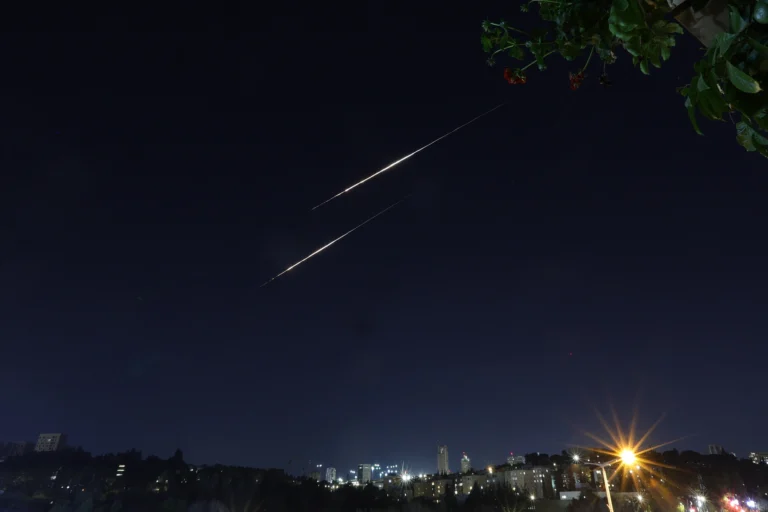
According to the Islamic Revolutionary Guard Corps these attacks are a direct response to the assaults launched by the Washington-Tel Aviv axis on February, 28. Photo: EFE.
March 6, 2026 Hour: 4:33 pm
🔗 Comparte este artículo
Iran launched on March 6 the 22nd wave of “Operation True Promise 4,” deploying new-generation ballistic and hypersonic missiles, in a response to the U.S.-Israeli massive air assault that shattered months of relative calm.
Iran began the 22nd wave of Operation “True Promise 4”, using for the first time massive new-generation missiles against strategic points in the territories occupied by Israel and U.S. military bases in the Persian Gulf region, under a sovereign response to a massive air aggression launched by the United States and Israel on February 28, 2026.
This initial attack, dubbed “Epic Fury” by Washington, struck multiple Iranian cities and strategic centers, shattering months of relative calm and activating the Islamic Republic’s total defense protocols following denunciations of severe violations of its territorial integrity.
RELATED: We’re Committed to Peace, but We’ll Not Hesitate to Defend Our Nation: Pezeshkian
This operation included the launch of high-tech missiles Khorramshahr-4, Khaibar and Fattah, which hit military centers in Haifa, Ben-Gurion airport and various U.S. facilities in Persian Gulf countries. From Tehran, the authorities pointed out that this deployment nullifies Western narratives that attempt to show an alleged weakening of the Persian nation’s defensive capabilities.
The effectiveness of the Iranian counteroffensive can be seen with the activation of emergency alarms in the Tel Aviv district and several nearby localities, confirmed by reports from the center of the occupied territories, which demonstrates that the hypersonic technology has succeeded in drilling again into the Zionist regimes defense system at strategic points of high military sensitivity.
Escalating Regional Conflict
In just seven days of intense conflict, Tehran has unleashed 22 waves of attacks, utilizing over 800 ballistic missiles and 1,700 drones, primarily targeting the command infrastructure of the U.S. Fifth Fleet and various air bases located in occupied territories. This series of Iranian counter-strikes represents a significant escalation in regional hostilities, marking a critical juncture in the geopolitical landscape of the Middle East.
The initial aggression on February 28, initiated by U.S. and Israeli forces, involved a large-scale air assault that impacted key Iranian urban areas and vital strategic installations. This move by Washington and Tel Aviv abruptly ended a period of relative calm in the region, triggering immediate and stringent defense protocols across the Islamic Republic.
Tehran condemned these actions as grave violations of its territorial integrity, signaling a firm resolve to retaliate. The magnitude of the initial strike prompted Iran to activate its comprehensive defense strategies, indicating a preparedness for a sustained confrontation and highlighting the fragility of regional stability.
In the ensuing seven days since the conflict began, Iran’s “Operation True Promise 4” has demonstrated a substantial capacity for retaliation. The Iranian military has conducted an extensive series of 22 attack waves, employing a formidable arsenal that includes more than 800 ballistic missiles and 1,700 drones.
These precision-guided strikes have been specifically aimed at paralyzing the command infrastructure of the U.S. Fifth Fleet, a critical American military presence in the Persian Gulf. Additionally, Iranian forces have targeted several air bases situated in occupied territories, signaling an intent to degrade the operational capabilities of opposing forces and assert its defensive posture across the region.
Iranian sources have reported that the initial aggression on February, 28 and the subsequent days of conflict have resulted in at least 1,332 dead.
These reports further suggest that the combined casualties among U.S. military personnel and Zionist occupation forces in various strategic points across the Gulf region may exceed 700 personnel, categorized as either wounded or neutralized.
Author: Laura V. Mor
Source: Al Mayadeen/ Al Jazeera